When you’re moving freight, the terms “freight broker” and “3PL” often get used interchangeably. They are related, but they are not the same.
Understanding the difference matters because it directly impacts how your shipments are managed, how issues are handled, and how much control you have over your supply chain.
If you choose the wrong model, you may get capacity, but not consistency.
What Is a Freight Broker?
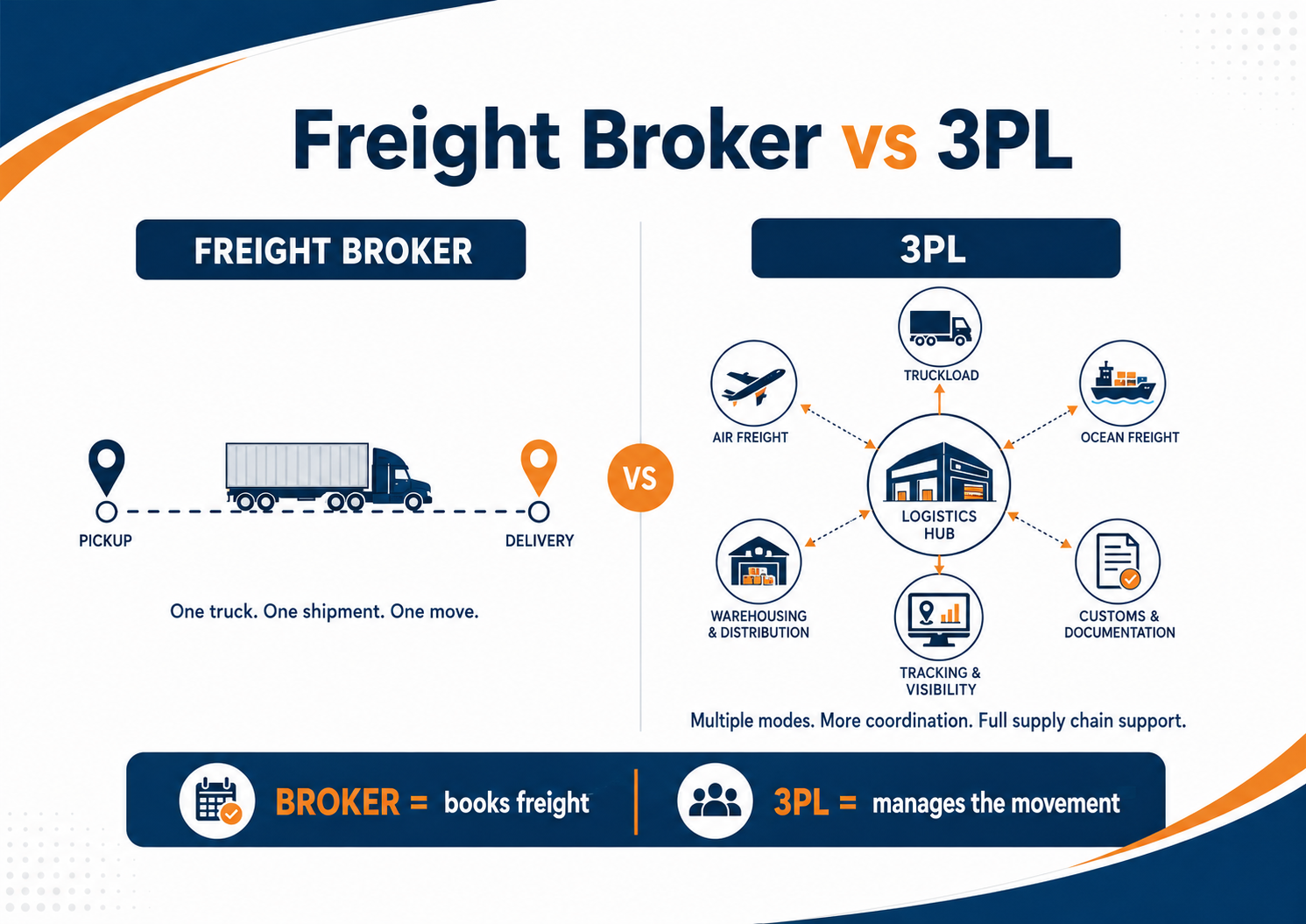
A freight broker acts as an intermediary between shippers and carriers. Their primary role is to secure transportation capacity.
When you work with a broker, they:
- Source a carrier for your shipment
- Negotiate the rate
- Coordinate pickup and delivery
- Freight brokers typically are focused only on North American ground shipments
In many cases, the broker does not physically handle the freight or manage broader supply chain functions. Their focus is on matching your shipments with available carriers.
What Is a 3PL?
A third-party logistics provider (3PL) offers a broader set of services that go beyond booking freight.
A 3PL typically manages:
- Transportation across multiple modes
- Carrier relationships and performance
- Warehousing and distribution
- Customs and cross-border coordination
- Ongoing shipment monitoring and issue resolution
The role of a 3PL is to manage transportation as part of a larger supply chain, not just secure a truck. A 3PL will manage the end-to-end movement of your shipment.
The Key Difference: Transaction vs Management
The simplest way to look at it:
- Freight broker = transaction-focused servicing North American shipments by ground
- 3PL = management-focused servicing North American AND Global shipments by all modes
A broker helps you move a shipment.
A 3PL moves your shipment(s) AND helps you manage how shipments move over time. This provides a much greater value-add.
How This Plays Out in Real Operations
The difference becomes clearer when something doesn’t go as planned.
With a freight broker, once the load is booked, communication often shifts to the carrier. If there is a delay or issue, resolution may depend on how quickly the broker can reconnect and respond.
With a 3PL, there is typically ongoing oversight. Shipments are monitored, and issues are addressed as they happen, with coordination across carriers, warehouses, and internal teams.
Where Freight Brokers Work Well
Freight brokers can be effective in certain situations:
- Full Truckload shipments within North America
- Spot shipments or one-off moves
- Accessing capacity in tight markets
- Simple lanes with minimal complexity
If your priority is securing a truck quickly, a broker can be a good fit.
Where a 3PL Adds More Value
A 3PL becomes more valuable as complexity increases:
- Ongoing shipment volume
- Multiple lanes,regions, or countries
- Cross-border or international freight
- Time-sensitive or high-value shipments
- Need for coordination across services
In these cases, the ability to manage, monitor, and adjust shipments is often more important than simply booking them.
Cost vs Value
Freight brokers are often perceived as a lower-cost option because they focus on individual transactions.
However, cost is not just the rate on a shipment. It includes:
- Time spent managing issues
- Delays and missed deliveries
- Lack of visibility
- Impact on customer relationships
A 3PL may not always have the lowest upfront rate, but it can reduce total cost by improving reliability and reducing disruption.
Visibility and Control
One of the biggest differences is how much visibility and control you have.
With a broker, visibility often depends on updates from the carrier.
With a 3PL, there is typically more structured tracking and communication, along with proactive management when something changes.
That difference becomes critical when shipments are time-sensitive or customer-facing.
Which One Do You Need?
The right choice depends on your operation.
You may benefit from a freight broker if:
- You ship infrequently
- Your lanes are simple
- You mainly need help finding capacity within North America
You may benefit from a 3PL if:
- You manage regular shipment volume
- Your network is growing or changing
- You need consistent service and oversight
- Your customer commitments depend on reliable delivery
Final Thoughts
Freight brokers and 3PLs both play a role in moving freight. The difference is how involved they are in the process.
A broker helps you book a shipment.
A 3PL helps you manage your transportation.
If your priority is short-term capacity, a broker can usually get the job done. If your priority is consistency, control, and protecting your delivery commitments, a 3PL provides a more complete solution.
Choosing the right approach comes down to how much support you need, and how much risk you are willing to manage internally.
As a broker AND third-party logistics provider, Journey works alongside your team to manage transportation beyond the initial booking. That includes coordinating carriers, monitoring shipments in transit, and responding quickly when something changes. The goal is simple: keep your freight moving as planned and help you deliver on the commitments you’ve made to your customers.