If you ship LTL freight, freight class plays a direct role in what you pay, how smoothly your shipment moves, and whether you deal with unexpected charges after delivery.
The issue is not complexity. It’s visibility. Many teams don’t realize a classification is wrong until the invoice changes or a shipment gets held. By then, you are reacting instead of staying in control.
This guide breaks down freight class in practical terms and shows how to avoid the mistakes that create cost overruns and service issues.
What Is Freight Class?
Freight class is a standardized system used to categorize LTL shipments based on how difficult they are to transport. It is defined by the National Motor Freight Classification system, commonly called NMFC.
Each shipment is assigned a class from 50 to 500.
- Class 50–85: Dense, easier-to-handle freight
- Class 92.5–175: Average density and handling
- Class 200–500: Lightweight, bulky, fragile, or higher-risk freight
Carriers use this classification to support pricing and determine how freight fits within their network.
The 4 Factors That Determine Freight Class
Freight class is based on four key characteristics:
Density – How much space your shipment takes up relative to its weight. Higher density typically means a lower class and lower cost.
Stowability – How easily your freight can be stored with other shipments. Odd shapes, restricted freight, or freight that cannot be stacked can reduce efficiency.
Handling – How easy it is to move. Standard pallets are simple. Fragile, oversized, or irregular freight requires more care.
Liability – Risk of damage, theft, or loss. Higher-risk freight can lead to a higher classification.
Freight Class Chart: Density-Based Guideline
In many cases, density plays a major role in freight class. The chart below is a general density-based guideline, not a guaranteed classification. Final freight class may also depend on handling, stowability, liability, NMFC item number, packaging, and carrier review.
Density (lbs per cubic foot) | Freight Class |
50+ | 50 |
35 – 49.99 | 55 |
30 – 34.99 | 60 |
22.5 – 29.99 | 65 |
15 – 22.49 | 70 |
13.5 – 14.99 | 77.5 |
12 – 13.49 | 85 |
10.5 – 11.99 | 92.5 |
9 – 10.49 | 100 |
8 – 8.99 | 110 |
7 – 7.99 | 125 |
6 – 6.99 | 150 |
5 – 5.99 | 175 |
4 – 4.99 | 200 |
3 – 3.99 | 250 |
2 – 2.99 | 300 |
1 – 1.99 | 400 |
Less than 1 | 500 |
How to Calculate Freight Class
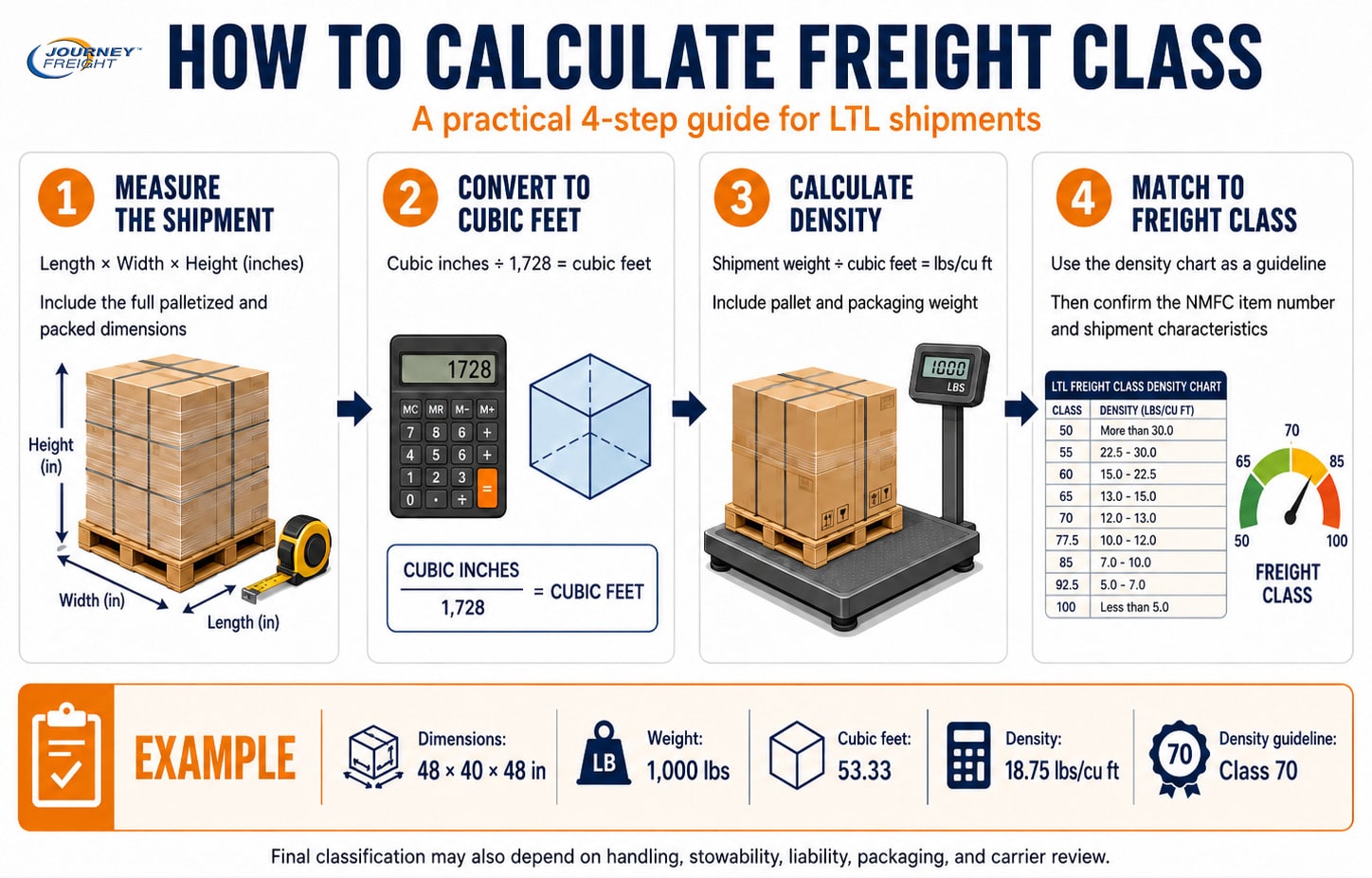
If your freight is not tied to a fixed NMFC item, density calculation is often the starting point.
Step 1: Measure the shipment
For each piece in the shipment, multiply the length × width × height in inches. This will give your total cubic inches. (Include the full palletized and packed dimensions)
Step 2: Convert to cubic feet
Divide total cubic inches by 1,728. This will give you the total cubic feet.
Step 3: Calculate density
Divide total actual shipment weight by the cubic feet. (Include the pallet and packaging weight.)
Step 4: Match to the chart
Use the density table above as a guideline, then confirm against the applicable NMFC item number and shipment characteristics.
Example
- Dimensions: 48 × 40 × 48 inches
- Weight, including pallet and packaging: 1,000 lbs
Cubic feet = 53.33
Density = about 18.75 lbs per cubic foot
Based on density alone, this would generally point to Class 70. Final classification may still depend on the NMFC item number, packaging, handling, fragility, stowability, liability, and carrier review.
Why Freight Class Matters
Cost Control – Higher class usually means higher cost. Even small changes in density can shift pricing.
Billing Accuracy – Incorrect classification can lead to reweigh and reclass charges after delivery.
Transit Reliability – Shipments flagged for inspection or correction can be delayed within terminal networks.
Customer Impact – Delays and unexpected charges do not stay internal. They affect delivery commitments and your customer’s experience.
The Most Common Freight Class Mistakes
Guessing the Class – Relying on memory or past shipments instead of current data.
Incorrect Measurements – Even minor errors in dimensions can shift density enough to change class.
Excluding Pallet or Packaging Weight – Freight density should be based on the full shipped unit, not just the product itself.
Packaging Changes – Different packaging can affect stackability, density, and handling.
Wrong NMFC Code – Using an outdated or incorrect classification code creates risk of reclassification.
No Pre-Shipment Validation – Issues are often caught only after the carrier inspects the freight.
How to Avoid Costly Errors
Standardize Measurements – Capture consistent dimensions and weights at the dock.
Verify NMFC Codes – Confirm classification based on the actual product and packaging.
Include Pallets and Packaging – Use the full shipped weight and dimensions when calculating density.
Improve Packaging – Denser, stackable freight often reduces class and cost.
Review Before Booking – Validate class before the shipment is tendered.
Work With a Partner Who Checks – A proactive review process helps catch issues before they impact cost or delivery.
Final Thoughts
Freight class is one of the most overlooked drivers of LTL performance. When it’s handled correctly, shipments move more predictably and pricing stays consistent. When it’s not, issues surface late and impact both cost and service.
The goal is not just to classify freight. It’s to avoid surprises that affect your operation and your customer’s expectations.